|
|
|
Whirling disease
ARTICLE BY
CODY BEERS
PHOTOGRAPHY BY
RICHARD GROST,
LURAY PARKER,
TIM CHRISTIE,
BARRY NEHRING, AND
CHRIS MADISON
An imported disease
and western trout
Defying gravity is a passion of humans. We're in awe of the act. Astronauts are our heroes, and airplane pilots are our idols. Maybe that's part of the reason why fishermen hold rainbow trout in such high regard. Rainbows are leapers.
Hurling themselves out of the water for anglers is one of the things rainbow trout do best. This leaping ability has brought them fame and fortune. But so has their availability to ordinary anglers such as you and me.
Today, rainbow trout are found almost everywhere in the West, including Wyoming, the Great Lakes and the East, Canada, cold streams throughout the South and cold stretches of rivers below dams in Texas, Oklahoma, Tennessee and Arkansas. More than other trout species, rainbows have proven they do well in a wide variety of habitats and climates. They are found in shallow and deep lakes, in small and large streams, in several of the Great Lakes and in some saltwater areas. All rainbows really need is cold, clean water, but they even survive in marginal conditions in some places.
Rainbows have a weakness, though. Rainbow trout are more susceptible to whirling disease than any other species of trout. In the 1990s, fisheries managers in Montana and Colorado discovered the disease's effects on their rainbow trout. What they've found has generated hysteria, paranoia and the largest effort to control a fisheries disease in modern history. Montana's and Colorado's situations are being watched by other states, including Wyoming, who more and more, are detecting the presence of the whirling disease parasite in their waters. Some states are merely watching and monitoring their waters. Other states, including Wyoming, are aggressively and attempting to keep the parasite from invading hatcheries and from spreading further into valuable wild-trout waters.
 |
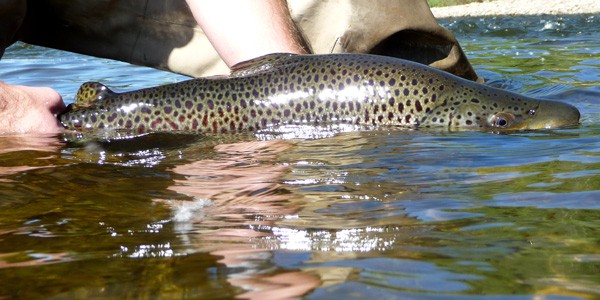
Whirling disease can reduce the number of wild fish in an affected stream, and if hatcheries are infected, there may also be fewer fish for stocking. The design of Wyoming's hatcheries combined with an aggressive testing program has kept the state's hatchery stock free of whirling disease. Further precautions are being taken. (Photo by Richard Grost)
|
Montana's Madison River was the model of a wild trout fishery before 1991. But in the fall of 1991, fisheries workers documented declines in wild trout numbers in the Pine Butte section of the river. The decline was unusual, because it only affected wild rainbow trout. Two years later, workers noticed another decline in wild rainbow trout almost thirty miles downstream in the Varney study section. By the fall of 1994, rainbow trout numbers had declined almost ninety percent in both study sections from historic averages in the 1970s and 1980s. Brown trout numbers were stable in this same period.
In December 1994, Montana fisheries workers collected young-of-the-year and yearling rainbow and brown trout from the Madison River from Quake Lake to Ennis Lake. The fish were tested for diseases, including whirling disease. A few weeks passed, and the confirmation came - some of the young trout were positive for whirling disease (Myxobolus cerebralis) spores. Samples taken in the fifty-five-mile reach of the river showed spores in up to seventy-five percent of the young fish that were examined. This was the first time whirling disease had been documented in Montana.
In 1995, an electrofishing survey of the Pine Butte and Snoball study sections of the Madison River documented clinical signs of whirling disease in Montana's wild rainbow trout. Clinical signs of the disease, such as head and body deformities, black tails and whirling behavior, were noted in up to fifty percent of the young-of-the-year rainbow trout. Young brown trout showed only light infections while rainbow trout infections were more severe.
Since 1994, the Montana Department of Fish, Wildlife and Parks has surveyed for the parasite in state waters through electrofishing, gill nets, fish traps and angling. Nearly 30,000 fish from more than 350 waters, including twenty-two hatcheries and some private ponds, have been tested for the presence of the whirling disease parasite.
To date, the parasite has been found in 73 Montana waters in 10 of 22 major river drainages. Montana's nine state, three federal, and 10 private hatcheries are not infected with whirling disease, nor have they ever been.
And although whirling disease poses no threat to humans who eat infected fish, the disease has affected Montana's income from trout fishing, which brings in about $250 million a year to the state.
Colorado first discovered whirling disease in 1988. At that time, Colorado Division of Wildlife scientists didn't believe the parasite was devastating, and they believed it could be controlled.
In 1993, Colorado fisheries workers found that young-of-the-year age classes of rainbow trout were missing from sections of the upper Colorado River. The cause: whirling disease. Since then, whirling disease has been found in parts of 14 of 15 major river drainages in the state. Losses of young fish have been documented in sections of the Colorado, South Platte, Poudre, Gunnison and Rio Grande rivers. Up to 300 of Colorado's 7,000 miles of streams may show population effects from the parasite.
Testing also revealed that whirling disease had infected eight of Colorado's 11 fish hatcheries. Prior to the findings, these hatcheries were producing more than 4.5 million catchable rainbow trout each year, and two million of these were being stocked on Colorado's West Slope.
Upon finding the disease, Colorado shut down rainbow production at some of these facilities and cut back production at others.
In 1994, before whirling disease was recognized as a threat to wild trout by Colorado, 125 rivers and streams were stocked with trout exposed to the parasite. By 1997, that number was reduced to portions of the Arkansas, Cache la Poudre, Colorado, East, Gunnison and South Platte rivers.
In 1996, Colorado adopted a new stocking policy that only allows trout testing negative for whirling disease to be stocked in waters that test negative for the disease. As a result, out of three million catchable rainbows produced in hatcheries last year, only 200,000 whirling disease-negative trout were stocked in West Slope waters. Whirling disease-exposed fish were stocked in eastern Colorado, however, where the parasite is already found.
Cuts in stocking has forced Colorado to reduce angler limits. The lower limits apply to waters west of the Continental Divide where the daily limit is two trout from streams and four trout in reservoirs and lakes. Colorado also added special catch-and-release regulations for new cutthroat waters on the West Slope and Rio Grande drainage.
Colorado is spending millions on its war on whirling disease, too. Colorado's legislature approved $10 million for the Division of Wildlife to spend on the first phase of its hatchery cleanup project, and the wildlife agency may seek up to another $10 million to fight the disease. Colorado is spending its money on six hatcheries that have the potential to be rid of the parasite— Mount Shavano, Finger Rock, Roaring Judy, Rifle Falls, Bellvue and Durango. The agency is focusing on cleanup of hatcheries that have secure ground water sources; hatcheries that rely totally on surface water may not be rehabilitated.
The effort is paying off, too. One Colorado hatchery, Mt. Ouray, has been certified negative for whirling disease through DNA testing, and two more (Bellvue and Durango) have initially tested negative for the disease. The success at Mt. Ouray is encouraging in that the parasite was first found there in 1986.
Colorado scientists are unsure if the hatchery improvements will totally purge the parasite, but they believe the improvements will eliminate the chances of other diseases entering the hatcheries. If the hatchery improvements proceed on schedule and testing remains negative for whirling disease, these hatcheries could be producing 1.9 million whirling disease-negative, catchable trout every year by 2002.
There is also evidence that suggests whirling disease may be involved in population declines in Idaho's Big Lost River and Utah's Beaver River. Other rivers in Idaho, Utah, Wyoming and other states, including New York, have the parasite, but they have not experienced declines in fish populations.
Idaho has had some problems with the parasite in at least three of its hatcheries.
The Disease
Whirling disease is not a mysterious parasite that suddenly appeared in the United States. It was first described in 1903 in Germany. In 1958, it was first reported in the United States in Pennsylvania. It is a disease of saimonids (trout, salmon, and grayling).
It is believed that whirling disease first came to the United States in 1956 in frozen food fish imported from Europe.
Since 1958, the whirling disease parasite has been found in hatcheries and/or in the wild in twenty-two states: Alabama, California, Colorado, Connecticut, Idaho, Maryland, Massachusetts, Michigan, Montana, Nevada, New Hampshire, New Jersey, New
Mexico, New York, Ohio, Oregon, Pennsylvania, Utah, Virginia, Washington, West Virginia, and Wyoming.
Whirling disease is caused by Myxobolus cerebralis, an internal myxosporean. About 1,300 species of myxosporeans seek fish, but only a few cause disease and still fewer kill their hosts.
 |
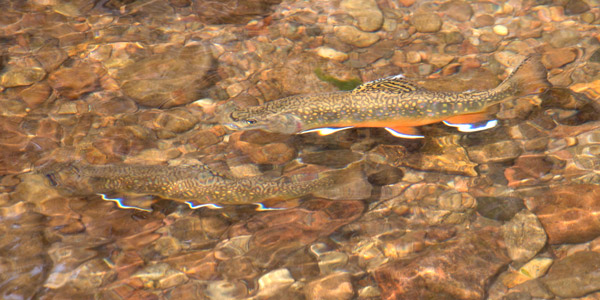
Some fisheries in Colorado and Montana have suffered major losses as a result of whirling disease. So far, Wyoming fish populations haven't seen similar reductions, even where the whirling disease pathogen has appeared. (Brook trout in water by Rich Grost)
|
The disease has two distinct life stages. One phase occurs in the host fish, and the other occurs in the Tubifex worm, a cousin of the common earthworm. There are more than sixty different tubificid worms in the world, but for whirling disease to happen, the
parasite must be ingested by the Tubifex worm.
Tubifex worms live in aquatic environments. They cannot swim, and they have no eyes. They are small reddish worms, usually about an inch long and often are found in dense numbers in nutrient-rich waters.
Spores of the whirling disease parasite are released into the water when a fish dies and decomposes or when it's eaten by scavengers. These spores are so small that thousands of them can sit on the head of a pin. Spores are also released in the feces of predators, including birds, that eat infected fish. When released, the spores are ingested by tubifex worms, and the cycle begins with development of the infectious stage of the spore (triactinomyxons or TAMs) in the gut of the worms. TAMs are shaped like grappling hooks and are much larger than the spores that infect tubifex worms. Fish can develop whirling disease by consuming infected worms or after the TAMs attach themselves to susceptible fish. TAMs begin to be released from infected tubifex worms about ninety days after exposure, and they can continue to be released for as long as one year after infection.
TAMs are very small, too, up to hundreds of times smaller than a human baby's eyelash. One Tubifex worm can carry up to 1,000 TAMs in its gut at one time.
Inside the susceptible fish, the parasite multiplies and migrates to the nerves. Once in the nerves, the parasite is shielded from the fish's immune response. The parasite migrates to the cartilage and does its real damage while it's digesting the cartilage. In the cartilage, the parasite transforms into the tiny spores that infect the tubifex worms, and the life cycle continues.
Young fish, usually rainbows from one to three inches long, are most often affected. TAMs attack a young fish's soft cartilage, which results in deformities and, often, death. Older fish can become infected with the parasite, but they usually don't suffer
external deformities because their cartilage has already hardened into bone.
Whirling disease impacts can be dramatic on susceptible fish – darkening of the tail (black tail), frenzied tail chasing (whirling) by fish when they are feeding or are disturbed, skeletal deformities of the head and spine, and heavy mortalities in young fish. Whirling disease may also result in reduced performance of infected fish and may make them more vulnerable to other diseases.
Whirling disease cannot be spread from fish to fish.
The intensity of whirling disease infection depends on a variety of factors. Environmental conditions such as pollution, crowding, and abnormal temperatures generally cause fish to be more susceptible to diseases. Fish exposed to higher doses ofTAMs can have more severe cases of whirling disease. Older fish are less susceptible to disease than younger fish, especially since the cartilage affected by the parasite converts to bone as fish age. Different species offish are more susceptible to whirling disease. Generally, rainbow and cutthroat trout and chinook and kokanee salmon are among the most susceptible species while brown trout, arctic grayling, and coho salmon are highly resistant.
Researchers have found that TAMs will attack almost any fish, but only trout seem unable to ward off the disease. They also found that TAMs do not attack freshly-killed trout or dead trout.
Ecological factors may play a role in the severity of the disease on wild trout populations. Whirling disease infection seems to be greater in high productivity streams. Water with more sediment and organic matter may enhance disease problems, because it
provides habitat for tubifex worms. Water temperature may have an effect, too. It appears that tubifex worms release more TAMs in warmer water than in colder water.
While it hasn't happened in Wyoming, one way whirling disease is spread is by moving live, infected fish during fish stocking and culture activities. Some states do not stock infected fish. In other states, infected fish are only stocked in waters where the whirling disease parasite is already found or where infected fish have been stocked in the past.
Once whirling disease is in a natural system, it can spread as infected fish move upstream or downstream and as TAMs are carried downstream. The parasite may also be carried by predators that eat infected fish and shed the spores in their feces. The spores may also be transferred through mud moved between infected and uninfected waters. Mud on anglers' waders, boots, boats, vehicles, construction equipment, or other items has the potential to spread spores. Fish eggs do not become infected, so disinfected shipments of eggs should not spread the disease.
Research is ongoing at developing ways to control whirling disease in fish culture areas. Effective ways of eliminating spores include ultraviolet irradiation, chemicals such as calcium oxide and chlorine, and heat. The spore – harmless to humans – can be destroyed by cooking the fish at 140 degrees for ten minutes. Whirling disease spores can survive for decades in
streambed mud.
 |
Fishermen can help with the effort to control whirling disease by reporting deformed fish to the Game and Fish authorities. In addition to deformities in the head and spine (below), fish with whirling disease often have blackened tails (left). (Deformed fish images courtesy of Barry Nehring, Colorado Division of Wildlife)
 |
Highlights of research for 1999 include a study in Colorado that indicates offspring of trout that have survived whirling disease might be less susceptible to heavy infections of the parasite than trout that have not been exposed.
Researchers in Montana are imprinting the fry of susceptible trout species to spawn earlier in spring, before warming waters increase parasite levels.
In Wyoming
Spores of the whirling disease parasite were first detected in Wyoming during 1988. The spores were found in trout collected from private farm ponds and nearby streams and lakes in the Laramie and North Platte river drainages.
Since then, the parasite has been found in trout from the Salt River and Green River (including the lower New Fork) drainages in western Wyoming and the South Fork of the Shoshone River drainage in northwest Wyoming.
Recently, a brook trout and a brown trout tested positive for the parasite in Webster Creek, the Idaho creek which feeds water to brood fish ponds at the Wyoming Game and Fish Department's Auburn Hatchery in eastern Idaho.
The parasite was also been found last fall in Yellowstone National Park. They were found in Yellowstone cutthroat trout on the east side of Yellowstone Lake near the mouth of Clear Creek. Fish with clinical signs of whirling disease, including black tail, whirling behavior and deformities of the head and body, have been documented for rainbow trout in the Salt River and in Cedar Creek in the North Platte river drainage. No other fish with clinical signs of the disease have been found, and fisheries workers have not detected any depressed or missing year-classes of fish in any Wyoming waters.
Wyoming fisheries workers and scientists are monitoring the state's waters for the presence of whirling disease, says G&F fish pathologist Dave Money.
"As far as I'm concerned, it's not a panic situation," Money says. "People have been dealing with this bug since the 1890s in Europe, and they still have rainbow trout over there." Like other states dealing with whirling disease, Wyoming is studying the parasite. Much of Wyoming's research is happening at the University of Wyoming. Jim Rose, a psychology, zoology and physiology professor at the university, is studying the disease's effects on the central nervous system. Wayne Hubert, assistant leader of the Wyoming Cooperative Fish and Wildlife Research Unit and zoology professor, and his graduate students are looking at the effects of the parasite on Wyoming's wild fish populations in the Salt River. And, G&F forensic analyst Dee Dee Hawk is investigating new highly sensitive DNA methods to help improve the capabilities of finding the organism. Rose's research is supported by the National Science Foundation. G&F funding is going toward the research, as is some from The National Partnership on Wild and Native Coldwater Fisheries and the Whirling Disease Foundation in Bozeman, Montana.
The Whirling Disease Foundation, Inc., was established in 1995. Its mission is to raise funds needed for whirling disease research. The foundation supports field and laboratory research on a national scale, and selects research proposals for funding. It provides a forum for research coordination and information exchange.
"(Whirling disease's parasite) is a very unique organism in that it shares many of the characteristics of both the plant and animal worlds," Money says. "What we do know is that we've seen very few fish with any obvious signs of whirling disease (in Wyoming)."
Money and some researchers believe the best approach to dealing with whirling disease is to try to understand why the parasite is being found in the wild, and "to find out why it's doing what it's doing."
"I think the secret lies with maintaining our water quality, and that's been strongly suggested by studies on whirling disease," he says. "That's been strongly suggested about other diseases, too. When water quality declines, things seem to occur with diseases."

Rainbow trout (above) are particularly susceptible to whirling disease. If a young fish survives infection, it often shows deformities in the head and spine (below). Brown trout seem more resistant than rainbows and cutthroats to whirling disease. This may be due to their European origins–their forbears may have been exposed to the pathogen for generations. (Normal rainbow trout by Richard Grost; deformed rainbow trout courtesy of Barry Nehring, Colorado Division of Wildlife)

"When you have a polluted environment, polluted in an ecological sense with a lot of disturbance - any type of man-made, man-caused, animal-caused disturbance - it's going to disturb the balance," Money says.
"We need to constantly focus on the environment," Money says. "The fish are a reflector, just like a mirror, of what's going on in our environment. That's important, not only from a fisheries standpoint, from the wildlife communities and from our own personal health point of view. We need to know what's going on with water quality. Those studies are essential."
The presence of the whirling disease parasite in the Green River drainage has caused concern for two G&F hatcheries, Boulder Rearing Station and Daniel Hatchery.
In 1998, the whirling disease parasite was detected in Forty Rod Creek, a tributary of the Green River. The significance of Forty Rod Creek is that its path leads it near G&F's Daniel Hatchery. As a result, G&F plans to spend about $600,000 this year to protect the facility from whirling disease and to renovate outdated facilities. G&F will be compensated for 75 percent of the work from federal Sport Fish Restoration Program funding. "Beyond protecting it against whirling disease, the new building should enhance the quality of brood stock and overall facility production," says G&F hatchery coordinator Steve Sharon. "We've had up to 40 percent predation on our brood stocks there, both sensitive brood stocks of the Colorado River and Bear River cutthroat trout."
When Daniel's work is complete, the facility will be totally enclosed under a new 120- by 220-foot steel building. "When you cover a brood stock, a lot of the problems with post-spawning fungus are almost eliminated. This situation will give those brood stocks the opportunity to be a lot more productive," Sharon says.
Sharon says G&F had two choices at the Daniel Hatchery. "We could either close the facility or protect the facility," he says. "We're taking a proactive stance to prevent it from coming into the facility."
"We have clean facilities," Sharon continues. "We are being proactive and removing the chance of influence of whirling disease where we have had to make a choice."
"If a (G&F) facility becomes positive, those fish will not be stocked. We will not influence or increase the level of whirling disease in the wild," Sharon says. "We had only one choice at Daniel. If we didn't protect the facility, we would always run the risk of becoming positive (for whirling disease)."
With growing concerns in the Green River drainage, G&F also plans to spend about $200,000 this year to close the open water system at the Boulder Rearing Station, and another $120,000 to build a disinfection and storage facility near Boulder for G&F's fish spawning crew. Again, G&F will be reimbursed for seventy-five percent of the work from federal aid.
"Closing the water system will remove us from possible exposure," Sharon says.
G&F's spawning operation currently shares a 40- by 80-foot workshop building with department workers at the Boulder facility. Most of the spawning crew's equipment has been stored near the hatchery, too.
"It really hasn't been a good way of doing business," Sharon says. "We need to isolate our spawning operations away from the hatchery."
On the same property, G&F plans to construct another facility to house the disinfection and storage facility. The 50- by 60-foot building will have a 20- by 60-foot indoor bay where spawning equipment can be disinfected. The bay will have a sump, and water will treated with chlorine before sent to an evaporation pond.
"If there is any disease or any kind of parasite or bacteria, it's going to get nailed by chlorine and it will also be taken to an evaporation pond," Sharon says.
The facility "will also give our other crews - construction and fisheries a site to disinfect their equipment," Sharon adds. "This facility will eliminate any possible interaction between the hatchery and our spawning equipment."
G&F Fisheries Chief Mike Stone says one of the most troubling aspects is how the whirling disease parasite can show up in waters where the mode of transmission cannot be determined. "Based on what we have seen in recent years, we can expect additional locations to become infected," Stone says. "Whirling disease has already had an adverse effect on our operations. Additional time and expense have been incurred to insure that we don't contribute to the problem."
G&F has established protocols for dealing with the whirling disease parasite in its fisheries operations to "thwart further movement of Myxobolus cerebralis spores among drainages." These protocols include fish sampling guidelines to monitor for the parasite, fish culture sidebars to keep the parasite from being moved into drainages during stocking, and the use of a strong public relations campaign to keep anglers involved in preventing the spread of the parasite. Sharon believes the whirling disease issue has a strong political slant. He says most people believe that the disease is a problem with hatcheries and fish culture. "In Wyoming, we're not the source of the problem. We're part of the solution. Wyoming hasn't seen any dramatic changes in wild populations."
"It's kind of like dancing in a mine field," Sharon says. "We don't know what's going to happen. It's all speculation. The best thing we can do is be proactive.
"We are being proactive to prevent the wild from infecting a hatchery," he says.
If a Wyoming hatchery does become infected with the whirling disease parasite, action will be taken. "It will be quick and swift," Sharon adds. "It's not going to take a lot of thought. All positive lots (of fish) and all exposed lots will be destroyed."
Money, however, believes wildlife agencies should be wary of killing wild populations of fish to control disease. "What's going to happen down the road if our Colorado River cutthroats get whirling disease?" Money wonders. "Are we going to kill the last of that remnant population to get rid of this parasite? We are going to have to consider that down the road. It's going to happen. Methods are getting more sensitive to detect diseases and pathogens now, and pretty soon we're going to start finding out that more of these fish have diseases. We're going to find that we are not living in a sterile environment."
Sharon wonders, too, about the disease and why it continues to turn up in new places. "You want to know the ridiculous part? We have nine or 10 sites that we annually inspect for wild brood stock sources, and we've never seen whirling disease there," he says. "Maybe it's the environment. The spread of this parasite is happening due to a natural situation," he says. Stone believes Wyoming will continue to have viable trout fisheries. "We may see changes in certain drainages, and some types of fisheries may be different from what we have known," he says. "Others will likely remain unaffected."
"From a fisheries management perspective, the effects of whirling disease are still impossible to predict with certainty," Stone continues. "The base of knowledge about whirling disease is increasing, but plenty of unanswered questions remain. The parasite has been present in the United States for decades, and effects have been highly variable. Little or no effect has been documented in certain waters and states, while it has been devastating in others. The long-term effects in those waters where it has been devastating are unknown."
Plenty of unanswered questions remain. The general consensus among scientists involved in research is that whirling disease and its parasite can be controlled in hatcheries. Early results from Colorado's massive fight offer hope for hatcheries which test positive for the disease.
In the wild, though, it's another story. Once a wild area is infected, it's generally believed that the disease cannot be totally eliminated from the environment. Some states have seen encouraging signs that levels of infection can drop over time.
"There currently is no practical means of controlling whirling disease in the wild. There is growing concern that some potential approaches for control in the wild may lead to inadvertent environmental disruption, so caution is needed before jumping to apply an unproven cure" Stone says.
"One of the big challenges for fisheries in the future results from a modern, mobile global society. Exotic organisms from parasites to mollusks, fish species and vegetation are finding their way to new parts of the world with increasing frequency. Whirling disease is but one of these organisms which threaten aquatic systems worldwide," Stone adds.
Intense research on whirling disease continues and will happen well into the future. It's safe to say that whirling disease and its parasite are receiving their share of study and research money.
One thing's for sure. Researchers, fisheries managers, scientists and fishermen have a long-standing love affair with trout, salmon and grayling. The leaper of the group, the rainbow trout, won't likely disappear. But everyone in Wyoming, including fishermen, must learn to live with the threat posed by whirling disease and its parasite. They're here.
|
|